
When a loved one comes home after a knee replacement, the whole family feels two things at once. There is relief that the operation went well, and worry about what happens next. The good news is that with proper knee replacement physiotherapy at home, most patients in Karachi get back on their feet steadily. They do not need to travel to a clinic every day.
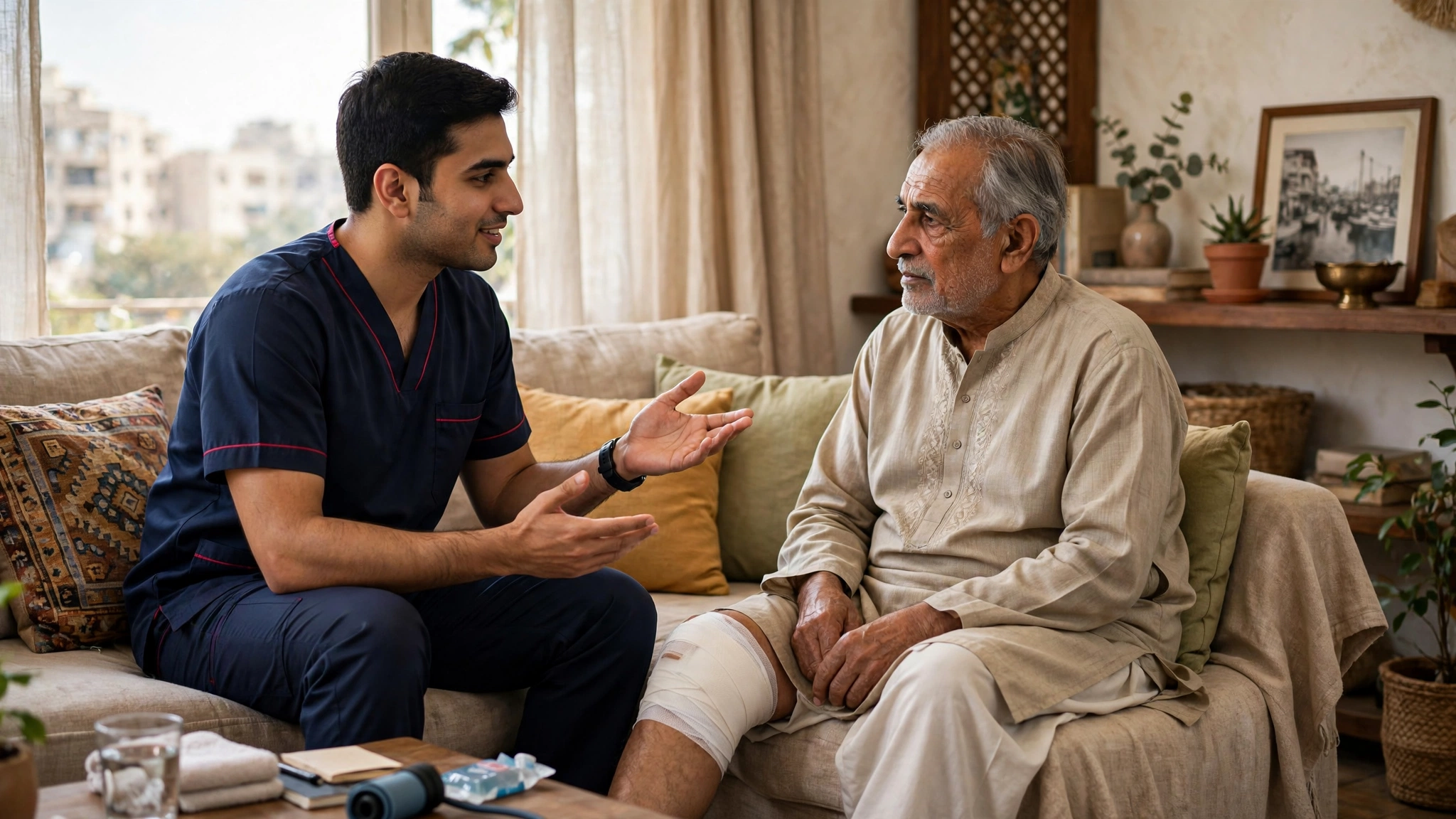
What Knee Replacement Physiotherapy at Home Involves
Knee replacement physiotherapy at home is a planned program of guided exercises and walking practice, done at the patient’s home by a trained physio after knee surgery. It reduces stiffness, rebuilds the muscles around the knee, and teaches safe ways to sit, stand, walk, and climb stairs during recovery.
The Physio’s Role at Home
A home physio does much more than count exercise repetitions. On the first visit, they check how the wound is healing. They measure how far the knee bends and straightens, test thigh muscle strength, and watch how the patient walks. Then they set small, realistic goals for each week. They guide the family. They show how to support the patient while walking, how to set up the bed and chair at the right height, and which movements to avoid. This supervision matters because wrong exercises can slow healing, while the right ones speed it up. If your loved one also needs help with daily tasks, our patient attendant in Karachi service can support them between physio visits.
Week-by-Week Recovery Expectations After Knee Replacement
Every patient heals at their own pace. The timeline below is a general guide, not a promise.
Week 1 to 2: The focus is on comfort and gentle movement. The knee will be swollen and sore. The physio helps the patient practice bending and straightening the knee within a comfortable range and take short walks around the room with a walker.
Week 3 to 4: Swelling usually starts to reduce. Walking distances increase slowly, and many patients move from a walker to a walking stick with the doctor’s permission. Thigh and hip exercises become a daily habit.
Week 5 to 8: The strengthening phase. The patient practices standing from a chair without arm support. They walk on flat surfaces more confidently, and do gentle stair practice with the physio beside them.
Week 9 to 12 and beyond: Most patients walk much more independently by this stage and manage daily activities with ease. The physio keeps working on full knee bending, leg strength, and a natural walking style. Some people take a little longer, which is normal.
Safe Exercises for Knee Replacement Physiotherapy at Home
These are the kinds of exercises a physio commonly includes after knee replacement. Do them only as prescribed by your doctor or physio.
- Ankle pumps: Move the foot up and down slowly. This helps blood circulation in the early days.
- Heel slides: Lying on the bed, slowly slide the heel toward the body to bend the knee, then slide it back.
- Straight leg raises: With the leg straight on the bed, tighten the thigh muscle and lift the heel a few inches. This rebuilds the thigh muscles.
- Seated knee bends: Sitting in a sturdy chair, slide the foot back under the chair to bend the knee, then straighten.
- Supported walking: Short, regular walks with a walker or stick, as advised.

Week-by-Week Recovery Milestones After Knee Replacement
| Weeks | Main goal | What the patient does |
|---|---|---|
| 1 to 2 | Pain control and first steps | Ankle pumps; short walks with a walker |
| 3 to 4 | Better knee bending | Heel slides; longer walks; stairs with support |
| 5 to 8 | Strength building | Stronger leg exercises; walking with less support |
| 8 and beyond | Return to routine | Longer walks; daily activities with care |
Every patient heals at a different pace. Your physio will adjust this plan to your progress.
Precautions and Warning Signs After Knee Replacement
What not to do: Do not sit on low sofas or floor cushions that force the knee into deep bending. Do not twist the operated leg while standing. Do not skip the walker or stick before your doctor says it is safe. Do not kneel on the new knee. Do not climb stairs without the railing and someone nearby in the early weeks. And do not start any new exercise on your own without asking the physiotherapist first.
When to call the doctor right away: Call your surgeon immediately if you notice any of these warning signs. These include increasing redness, warmth, or discharge around the wound, fever, sudden severe leg swelling, calf pain, chest pain, or difficulty breathing. Also call if the knee suddenly gives way or pain becomes much worse instead of gradually improving.

Why Families in Karachi Choose Elijah Health Care Services
After a knee replacement, the hardest part for many Karachi families is the daily travel. Taking an elderly patient to a clinic in traffic, waiting for turns, and bringing them back tired is exhausting. Our physiotherapy home service in Karachi removes that burden.
Recovery after surgery is not only about exercise. Elderly patients often need help with bathing, dressing, and moving around the house during the first weeks. Our elderly care services and trained attendants can look after these daily needs. Our male nurse in Karachi service is available if nursing-level support is needed.
Booking is simple. Call 0346 2371014 or message us on WhatsApp, and tell us about the surgery and the patient’s condition. You can also book an appointment online. We serve homes across Karachi, including DHA, Clifton, Gulshan, Bahria Town, and North Nazimabad.
Frequently Asked Questions
How soon after knee replacement surgery should physiotherapy start at home?
Physio usually begins within the first few days after surgery. Sometimes it starts before hospital discharge. Starting early helps prevent stiffness and improves blood flow. Your surgeon will tell you when it is safe to begin.
How many home physiotherapy sessions are needed after knee replacement?
The number of sessions depends on the patient’s age, health, and progress, but many patients benefit from regular sessions over 6 to 12 weeks. Your physiotherapist will adjust the plan week by week.
Can an elderly patient do knee replacement physiotherapy at home safely?
Yes, home physiotherapy is often the safest option for elderly patients because there is no tiring travel involved. The physio works at the patient’s pace and guides the family on safe assistance between visits.
What should the home be like for knee replacement recovery?
Keep walkways clear of rugs and clutter, arrange a firm chair with armrests at a good height, and keep the walker within reach. Your home physiotherapist can suggest small changes during the first visit.
Recovering from a knee replacement takes patience, but every week brings small victories. The first walk to the kitchen, better sleep, and more confidence. With the right knee replacement physiotherapy at home, your loved one can heal safely and regain independence step by step. Call 0346 2371014 today.
Please note: this article is for general information only and is not medical advice. Always follow the instructions of your surgeon and physiotherapist.